 Fuel
Fuel 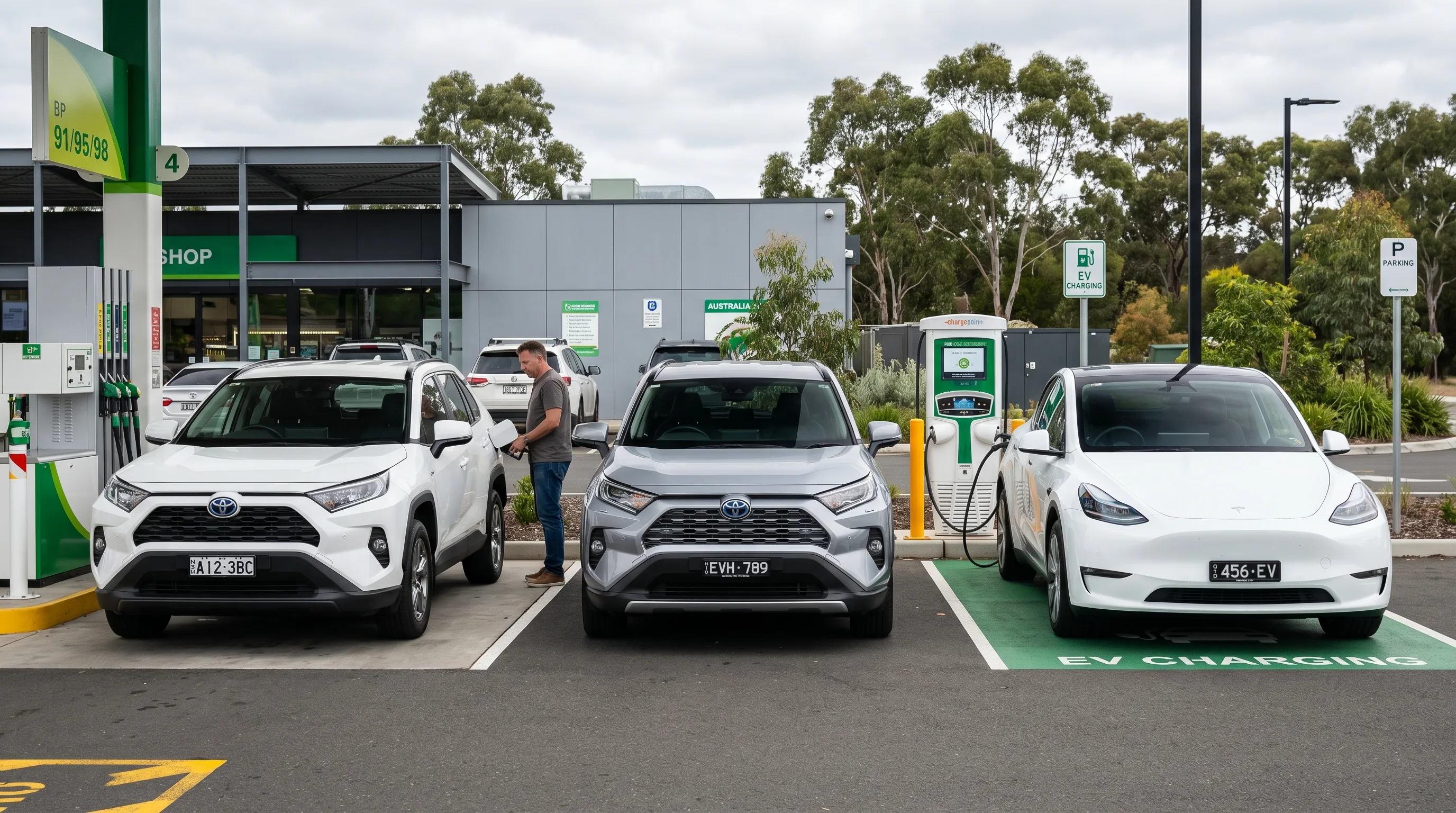
The fairest way to compare petrol, hybrid and electric cars is on cost per 100 km, and on that measure an EV charged at home is usually the cheapest, a hybrid typically cuts petrol use by around 30-40% versus a comparable petrol car, and a straight petrol car costs whatever the pump price you actually pay works out to. There are no fixed answers here, because the result swings entirely on your fuel price, your electricity rate, where you charge and how you drive. What follows is the method to work out your own real numbers, not a fake "EVs save you $X" claim.
The one number that matters: cost per 100 km
Sticker price, badge and brochure economy figures all distract from the question you actually care about: how much does it cost to move this car down the road? The clean comparison is cost per 100 km, because it puts a petrol guzzler, a frugal hybrid and a home-charged EV on the same scale.
For a fuel-burning car the maths is simple. Take the litres it uses per 100 km, multiply by the price per litre you pay, and you have your cost per 100 km. So a car using 8 L/100 km at a pump price of 180 c/L costs 8 × 1.80 = $14.40 per 100 km. Change either number and the answer moves, which is exactly why the price you pay at the bowser matters so much. Our trip and savings calculators do this for you, and the live fuel map gives you the real price near you to plug in.
For an EV the method mirrors it: take the energy it uses per 100 km (kWh/100 km), multiply by your electricity rate per kWh, and you have the cost per 100 km. A car using 16 kWh/100 km on a 30 c/kWh home tariff costs 16 × 0.30 = $4.80 per 100 km. Use a much cheaper off-peak or solar rate and that number drops further; use an expensive public fast charger and it can climb past petrol territory.
Petrol: it's all about the price you pay
A petrol car has no clever trick to lower its running cost beyond two things: how much fuel it uses, and how cheaply you buy that fuel. The first is fixed by the car. The second is entirely in your control, and that is where most people leave money on the table.
Pump prices swing wildly through the discounting cycle, and in the big cities the gap between the cheapest and dearest day can be substantial. Buying near the bottom of the cycle instead of the top can quietly knock a big chunk off your per-100 km cost without changing the car at all. We cover the timing in detail in our guide to the best time to buy fuel, plus the city-specific patterns in the Queensland 42-day fuel cycle and the NSW fuel price cycle.
Fuel choice matters too. Most cars run happily on regular, and paying for premium you don't need is wasted money, which we break down in premium vs regular petrol and E10 vs unleaded 91. If you want the full toolkit for trimming the petrol side, start with how to save money on fuel.
Hybrid: a petrol car that uses less petrol
A hybrid is still a petrol car at heart, but the electric motor handles low-speed and stop-start work where a petrol engine is least efficient. The practical result is that a hybrid typically uses noticeably less fuel than an equivalent petrol model, with the saving most commonly landing somewhere around 30-40% in the kind of driving where they shine.
Where they shine is the catch. Hybrids do their best work in city and suburban stop-start traffic, where regenerative braking and electric-only crawling cut petrol use the most. On a long, steady highway run the petrol engine does most of the work anyway, so the saving narrows. A hybrid that looks frugal around town will look much closer to a petrol car on a country drive.
Crucially, a hybrid still buys petrol, so everything in the petrol section still applies. The pump price you pay, the fuel grade and the discount cycle all flow straight through to your per-100 km cost. A hybrid simply scales those costs down by using fewer litres per 100 km. To estimate the saving, work out the petrol car's cost per 100 km, then reduce the litres figure by your expected percentage and re-run the maths.
EV: cheapest at home, dearest on the road
An electric car charged at home is usually the cheapest option per 100 km by a clear margin, because home electricity per kWh is far cheaper than the petrol equivalent of the same energy. Charge overnight on an off-peak tariff or from your own solar, and the gap widens further. This is the scenario where EVs genuinely undercut everything.
Public charging changes the picture. Fast and ultra-fast public chargers cost considerably more per kWh than home power, and if you rely on them the EV's running-cost advantage shrinks, sometimes to the point where it is no cheaper than a frugal hybrid. The decisive question for an EV buyer is not the car, it is whether you can charge at home. We dig into the full comparison in EV charging cost vs petrol.
Highway driving is the other twist. Petrol cars are at their most efficient cruising at a steady speed, while EVs lose more range at sustained high speed and may need a paid fast charge mid-trip. So the EV's "cheapest" crown is strongest for city and suburban running off home power, and weakest on a long highway haul charged at public rates.
How the three stack up
Because the real numbers depend on your prices, the honest comparison is about what drives the cost rather than a fixed dollar figure. Here is how the three line up on the levers that matter.
| Factor | Petrol | Hybrid | EV |
|---|---|---|---|
| What you pay for energy | Pump price per litre | Pump price per litre (fewer litres) | Home or public rate per kWh |
| Cheapest scenario | Bottom of the discount cycle | City stop-start driving | Home or solar charging |
| Dearest scenario | Top of the cycle, premium fuel | Long highway runs | Public fast charging |
| Usual per-100 km ranking | Highest | Middle | Lowest (charged at home) |
| You control the cost by | Buying fuel cheaply | Buying fuel cheaply, driving in town | Charging at home off-peak |
Notice that for petrol and hybrid, the single biggest lever you control is still the price you pay at the bowser. That is true whether you drive a thirsty ute or a frugal hybrid, and it is why checking live prices before you fill is worth the few seconds it takes.
Upfront cost vs running cost
Running cost is only half the story. EVs and hybrids usually carry a higher purchase price than a comparable petrol car, so a cheaper cost per 100 km has to make up that gap over the years and kilometres you own the car. The break-even point depends on how far you drive, what you pay to charge or fuel, and how long you keep the car.
- High-km, home-charging drivers recover an EV's price premium fastest, because the per-100 km saving is large and applied to lots of kilometres.
- City commuters who can't charge at home often find a hybrid the sweet spot: a real fuel saving without depending on a charger.
- Low-km or budget buyers may find a well-bought petrol car, fuelled smartly, still works out cheapest overall once the purchase price is counted.
Don't forget servicing, tyres, insurance and resale, which all sit outside the per-100 km figure but feed the true total cost of ownership. The per-100 km number is the cleanest single comparison, but it isn't the whole bill.
Work out your own real numbers
The only comparison that counts is yours, built from your prices and your driving. Here is the quick way to do it:
- Petrol or hybrid: grab the car's L/100 km, pull the real price near you off the live fuel map, and multiply. See what a tank actually costs in our rundown of what it costs to fill up popular cars.
- EV: take the car's kWh/100 km and multiply by your actual electricity rate, not a guess. Use your off-peak rate if you charge overnight.
- Both: run a real trip through the fuel calculators and the road trip fuel cost guide to see the per-100 km figures side by side.
If your choice is between a diesel and a petrol rather than going electric, that is a separate calculation worth doing properly, and we cover it in diesel vs petrol running costs. And if you live anywhere with a strong discount cycle, the suburb you fill in can matter as much as the car, which you can explore through your state hub such as QLD fuel locations or NSW fuel locations.
The takeaway is simple. An EV charged at home almost always wins on cost per 100 km, a hybrid cuts your petrol use without a charger, and a petrol car is only as cheap as the fuel you buy for it. Whichever you drive, the price at the pump is the one number you can change today, so check it before you fill.