 Fuel
Fuel 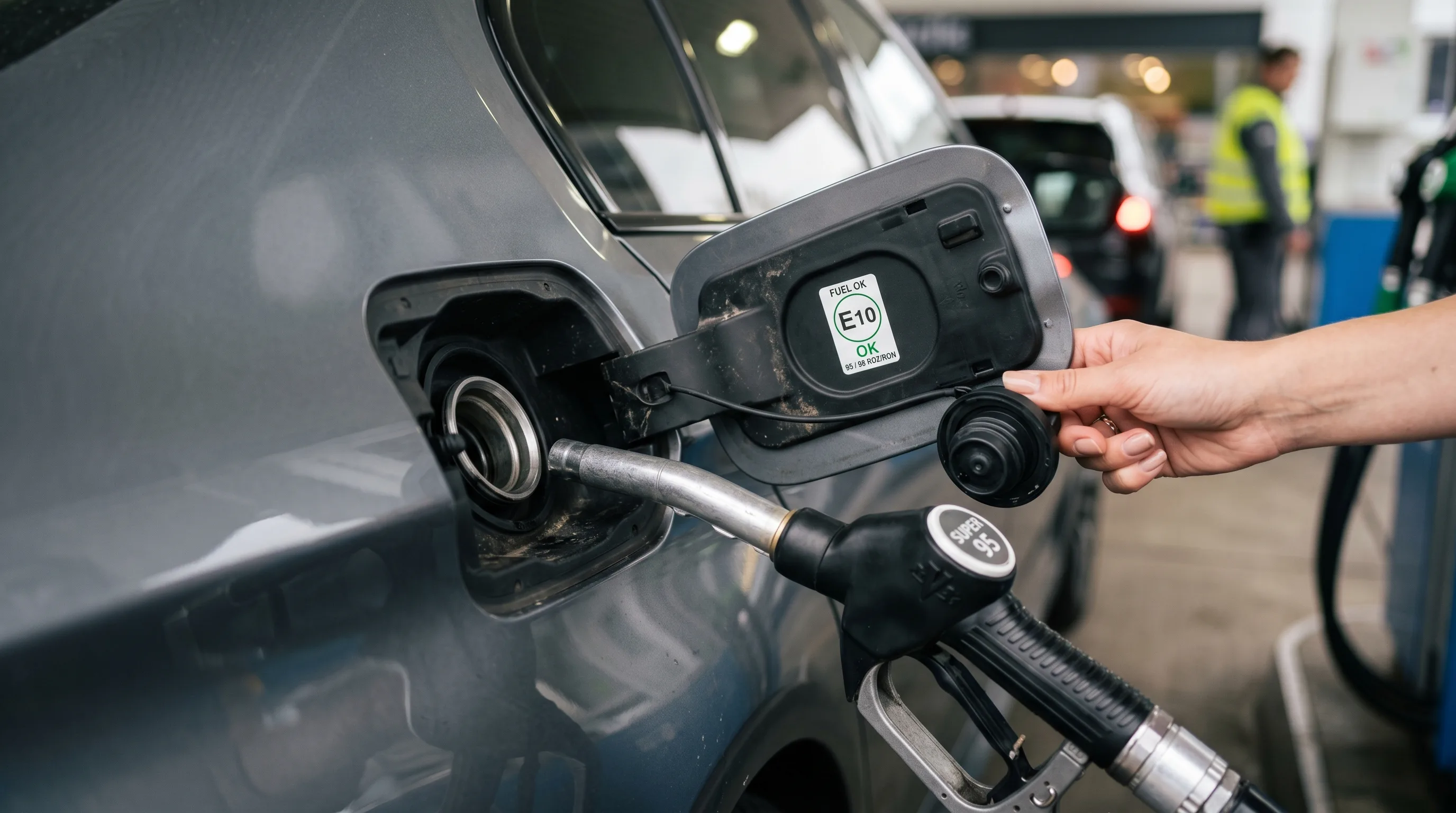
If your car is a petrol model built from roughly the year 2000 onward, it can almost certainly run E10 safely. Australian carmakers and importers have designed engines and fuel systems to tolerate up to 10% ethanol for well over two decades, so the vast majority of cars on the road today are fine. The only sure way to confirm yours is to check three places: the label inside your fuel filler flap, your owner's manual, and the manufacturer's published E10 compatibility list. If all three give the green light, you're good to go.
That's the short answer. The longer answer matters because there are real exceptions — some older cars, certain grey imports, and most small petrol engines should stick to standard unleaded. Below is exactly how to check, where the line falls, and why E10 isn't quite the free lunch it sometimes gets painted as.
What E10 actually is
E10 is regular unleaded petrol blended with up to 10% ethanol. Ethanol is a plant-derived alcohol, and that 10% top-up nudges the octane rating up — E10 typically sits around 94 RON, slightly higher than standard 91 unleaded. It's usually the cheapest petrol on the board, which is why so many drivers reach for it. If you want the full cost-versus-91 breakdown, our E10 vs Unleaded 91 comparison runs the numbers; this guide is purely about whether your car can use it at all.
Octane is the part that confuses people, so it's worth being clear: a higher RON number doesn't mean "better" fuel, it means the fuel resists knocking under compression. We unpack what those numbers mean in octane ratings explained, and how the standard and premium grades differ in premium vs regular petrol.
How to check if your car can use E10
Don't guess, and don't rely on a mate at the servo. Three checks settle it in under five minutes:
- The fuel filler flap. Open it and look for a sticker. Many cars from the mid-2000s onward carry a small label stating the minimum octane and whether E10 (or "E10 compatible" / "up to 10% ethanol") is acceptable. This is the fastest check.
- The owner's manual. The fuel section will spell out the minimum RON and ethanol tolerance. If you've lost the printed copy, manufacturers publish manuals online by model and year.
- The manufacturer's E10 compatibility list. Most brands publish a model-by-model list, and several state governments host an E10 fuel-check or compatibility tool that lets you look up your make, model and year. If the official list says yes, that's the authoritative answer.
Where the three sources agree, trust them. Where they don't — say the flap is blank but the manual is clear — go with the manual or the manufacturer's list over a missing sticker.
The 'minimum 91' rule
Here's the rule of thumb that covers most drivers: if your car is specified to run on minimum 91 RON unleaded, E10 is a suitable substitute. Because E10 lands around 94 RON, it comfortably clears the 91 minimum, which is why it's the everyday choice for the bulk of Australia's fleet.
The catch is the other direction. If your manual specifies a minimum of 95 or 98 RON — common on European cars, performance models and some turbocharged engines — then E10 is the wrong fuel, not because of the ethanol but because the octane is too low. Those cars need premium. If you're unsure which grade your car actually requires versus what's merely "recommended", the premium vs regular guide walks through how to read the difference.
| Your car's minimum fuel | Can it use E10? |
|---|---|
| 91 RON unleaded (most cars from ~2000 on) | Yes — E10 (~94 RON) suits it |
| 95 RON premium required | No — E10's octane is too low |
| 98 RON premium required | No — use 98 only |
| Pre-2000 / unknown tolerance | Check the manual or list first |
Vehicles that should NOT use E10
A minority of vehicles can be damaged or run poorly on ethanol blends. Ethanol attracts moisture and can be harsher on older rubber seals, hoses and certain fuel-system components that weren't built with it in mind. Steer clear of E10 in:
- Some pre-2000 petrol cars. Many older carburettor and early fuel-injected engines have seals and metals that don't suit ethanol. Check the manual; if there's no guidance, stick with standard 91 unleaded.
- Certain imported and grey-import vehicles. Cars not originally built for the Australian market may not be ethanol-rated. Verify against the manufacturer's specs before filling.
- Small petrol engines. Mowers, whipper-snippers, chainsaws, generators, outboards and other two- and four-stroke garden gear are frequently not E10-rated — check the equipment handbook.
- Older motorbikes. Many classic and older bikes have fuel systems that ethanol can degrade. When in doubt, use standard unleaded or the grade the maker specifies.
If you fall into any of these and you're not certain, the safe default is plain 91 (or whatever grade the maker lists). The handful of cents you'd save with E10 isn't worth a damaged fuel system.
E10 isn't a free lunch
Even when your car is fully compatible, E10 comes with one honest trade-off: ethanol carries slightly less energy than petrol, so E10 has a marginally lower energy density. In practice that means a very small drop in fuel economy — you may travel a touch fewer kilometres per tank than you would on standard unleaded.
For most drivers the price gap more than offsets that small efficiency loss, which is the whole point of choosing it. But it does mean the saving is the pump-price difference minus a sliver of economy, not the full headline gap. We crunch that properly in the E10 vs 91 piece, and there's broader fill-up advice in our guide to saving money on fuel. If you run a diesel rather than a petrol car, none of this applies — see diesel vs petrol running costs instead, since diesels never take ethanol blends.
Find the cheapest E10 near you
Once you've confirmed your car is E10-friendly, the next move is paying as little as possible for it. Prices swing day to day and street to street, so the live Fuel Daddy map is the quickest way to see who's cheapest right now near you. You can browse by area through the location hubs for Queensland, New South Wales, Victoria and Western Australia, or drill into a city like Brisbane, Sydney or Melbourne.
Timing matters too. Petrol prices move on a cycle in the big cities, so buying near the bottom can beat any fuel-type saving — see the best time to buy fuel and check the 14-day price trends before you commit to a top-up. Confirm your car, pick E10 if it qualifies, then fill up at the bottom of the cycle — that's how you save twice.