 Fuel
Fuel 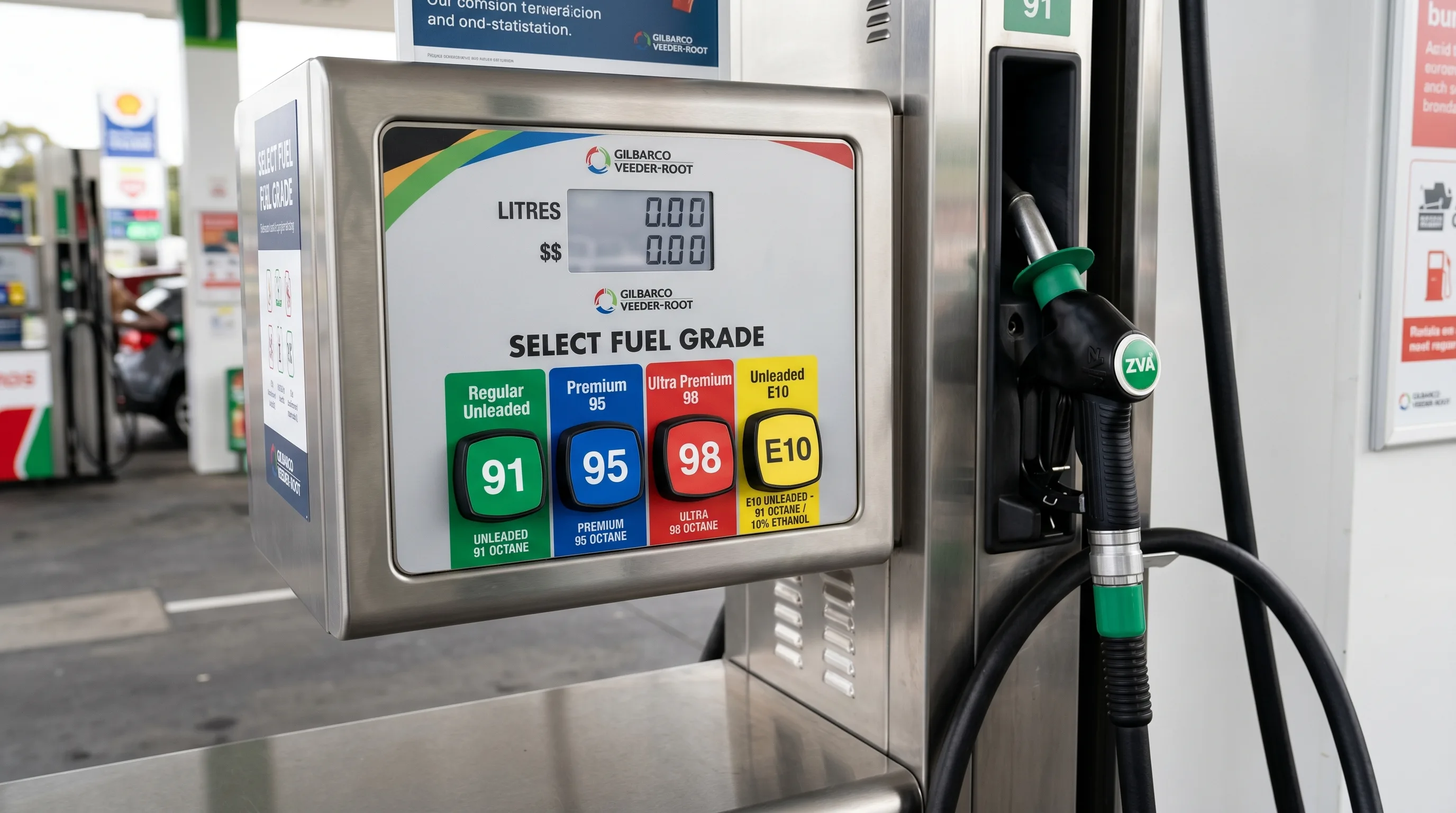
The number on the pump — 91, 95 or 98 — is the fuel's octane rating, measured in Australia as Research Octane Number (RON). It tells you how well the petrol resists "knocking" (pre-ignition) under pressure, not how clean, powerful or premium it is. The simple rule: use the minimum octane your car's manufacturer specifies and no less. Going higher than required almost never gives you more power or better economy — it just costs more per litre. Below is what each grade means, what knock actually is, and the handful of cases where premium fuel is genuinely worth it.
What octane (RON) actually measures
Octane rating is a measure of a fuel's resistance to knock. Inside a petrol engine, the air-fuel mixture is compressed by the piston and then ignited by the spark plug at exactly the right moment. If the fuel ignites too early — on its own, from heat and pressure, before the spark — you get an uncontrolled explosion called knock or pinging. A higher octane number means the fuel can withstand more compression before it self-ignites.
That's the whole story. Octane is not a measure of energy content, cleanliness or "premium-ness." A litre of 98 doesn't contain meaningfully more energy than a litre of 91. It's simply more stable under pressure. This is why pouring 98 into an engine built for 91 doesn't make the car faster — the engine was never designed to take advantage of that extra knock resistance.
The Australian petrol grades, side by side
Australian servos sell petrol in a handful of standard grades. Here's how they line up by octane rating and what they're designed for:
| Grade | RON (octane) | Best for |
|---|---|---|
| E10 | ~94 | Cars approved for E10 — a 91-substitute blended with up to 10% ethanol, often the cheapest at the pump |
| Unleaded 91 | 91 | The default for most older and mainstream petrol cars in Australia |
| Premium 95 | 95 | Many European and turbocharged engines that specify 95 minimum |
| Premium 98 | 98 | High-compression, high-performance and many turbo engines that specify 98 |
Diesel is a separate fuel entirely — it ignites by compression, not spark, so octane doesn't apply to it. If you're weighing up a diesel against a petrol model, our breakdown of diesel vs petrol running costs covers that properly. For everything below, we're talking petrol.
What knock is and why it matters
Knock is that metallic pinging or rattling sound you sometimes hear from an engine under load — climbing a hill, accelerating hard, or towing. It happens when pockets of the air-fuel mixture ignite before the spark plug fires, fighting against the piston instead of pushing it down smoothly. Persistent knock is bad news: at its worst it can damage pistons, valves and bearings over time.
Modern cars have a knock sensor that detects this and retards the ignition timing to protect the engine. That's why a car designed for 95 will usually still run on 91 in a pinch — it pulls timing to avoid damage — but you'll often lose a little power and economy in the process, which can cancel out the saving from the cheaper fuel. That trade-off is the heart of the premium vs regular petrol question.
The "minimum octane" rule — and where to find yours
Your car's manufacturer sets a minimum octane requirement based on the engine's compression ratio and design. That number is the one that matters, and it's easy to find in three places:
- Inside the fuel filler flap — most cars print a sticker like "Unleaded 91 minimum" or "Premium 95 only" right where you put the nozzle.
- The owner's manual — the fuel section spells out the minimum RON and whether E10 is approved.
- The manufacturer's website — the specs page for your exact model and year.
Once you know your minimum, the logic is straightforward. If your car says 91, you can use 91 or E10 (if approved) and pocket the difference. If it says 95 or 98 "minimum," that's a floor, not a suggestion — don't go below it. And if it says a grade "only" (no "minimum"), stick to exactly that. Whatever your number, you can see what every grade costs near you right now on the live fuel map before you commit to a station.
When premium fuel is genuinely worth it
Premium 95 and 98 earn their higher price in specific cases, not as a blanket upgrade. Spend the extra when:
- Your manufacturer specifies it. High-compression engines, most modern turbos and many performance and European cars are tuned to need 95 or 98. They make their rated power and economy on that fuel — feeding them 91 forces the engine to pull timing and run below its design.
- You hear knock on regular. If an older car pings under load on 91, a tank of higher octane can stop it. Persistent knock, though, is worth getting checked rather than papering over with fuel.
- You're towing or working the engine hard in a car that's borderline on 91 — the extra knock margin can help under sustained heavy load.
When it's just money down the drain
For the majority of cars on Australian roads — anything happily specced for 91 — buying 95 or 98 is usually wasted spend. The engine can't extract the extra knock resistance it doesn't need, so you won't see more power, more economy or a cleaner engine. The marketing claims about "premium" fuels cleaning your engine are largely about detergent additives, and most standard fuels already carry enough to keep injectors clean in normal use.
That premium price gap — often 10 to 25 cents a litre over regular — adds up fast across a year of fill-ups for zero benefit if your car doesn't need it. We've run the numbers on that exact decision in E10 vs Unleaded 91 and the broader premium vs regular comparison, and the pattern is consistent: match the fuel to the spec, not to the marketing. For more ways to trim your bill, see our guide to saving money on fuel.
Where E10 fits in
E10 is regular unleaded blended with up to 10% ethanol, which lifts its octane to around 94 RON — comfortably above 91. It's often the cheapest option on the board, but it carries slightly less energy per litre than straight petrol, so you may use a touch more of it. The big caveat is compatibility: not every car is approved for ethanol blends, and running E10 in a car that isn't can cause problems over time.
Before you switch, check your car against the approved list in our guide to whether your car can use E10. If it's cleared, E10 is a fine, cheaper substitute for 91 in everyday driving.
The bottom line
Octane is knock resistance, full stop. The number on the pump tells you how much compression the fuel can take before it pre-ignites — nothing more. Find your car's minimum RON on the filler flap or in the manual, buy that grade (or E10 if approved), and only step up to 95 or 98 if your manufacturer says so or your engine knocks. Everything else is paying for a property your engine can't use.
Whatever grade your car takes, prices for it swing day to day. Time your fill with our guide to the best time to buy fuel, watch the cycle on the live price trends page, and find the cheapest station for your exact grade across Queensland, New South Wales and Victoria on the live map. Planning a longer drive? Plug your car into the trip cost calculators to see exactly what a tank of your grade will cost.