 Fuel
Fuel 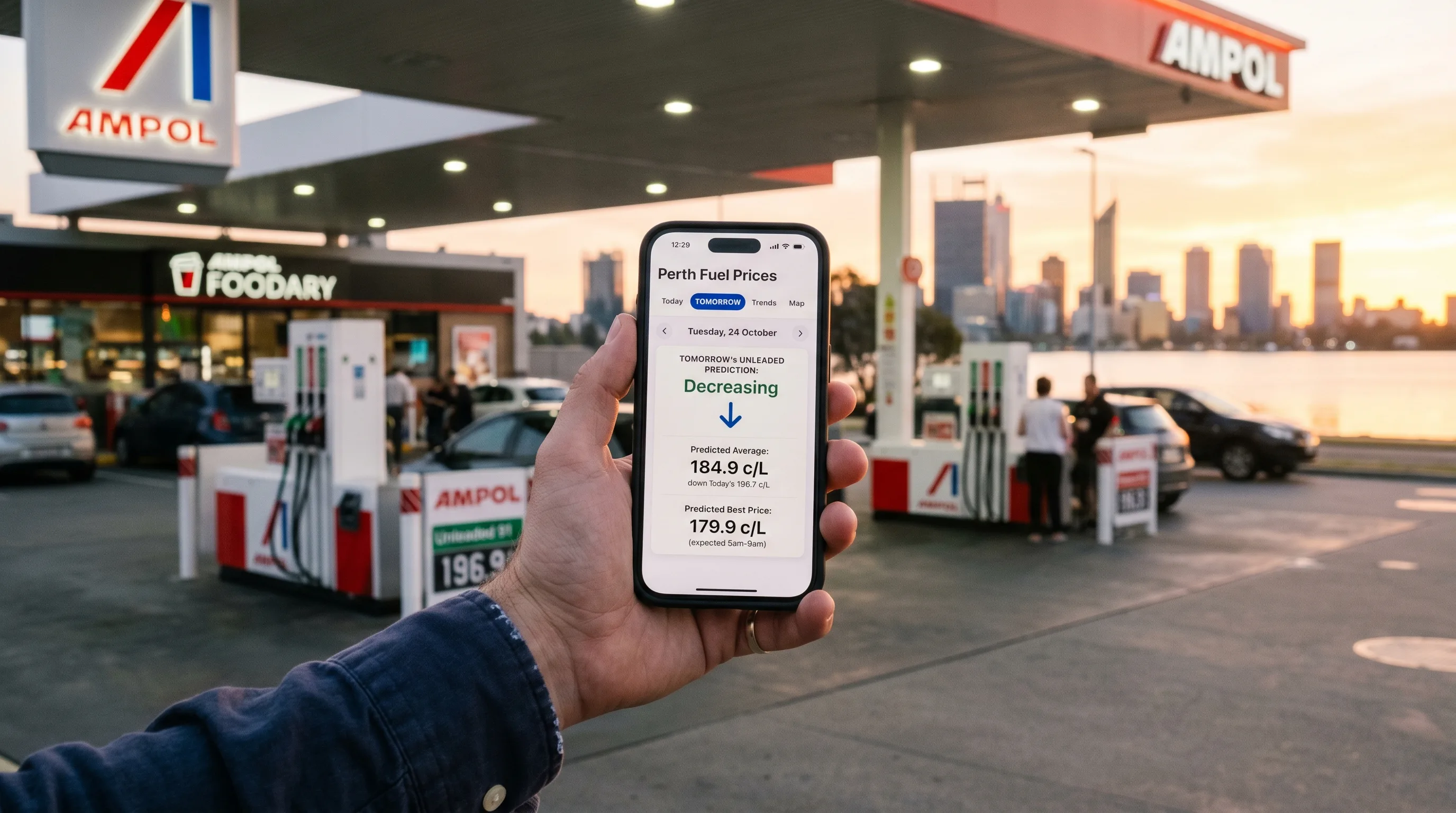
Western Australia is the only Australian state where you can see tomorrow's fuel prices today. Under the FuelWatch scheme, every WA petrol station has to lock in its next-day price by 2pm, and those prices are published from around 2:30pm for the following day — then frozen for a full 24 hours. Once a station sets a price it cannot move it until the next cycle, so the number you see in the afternoon is exactly what you'll pay at the bowser tomorrow. That removes the guesswork that drivers in every other state live with, and it lets you plan a fill with certainty.
If you just want the cheapest WA prices right now, the fastest path is the live Fuel Daddy map, the WA fuel locations hub, or the dedicated Perth fuel prices page. And if you're outside WA and wondering whether your state has a FuelWatch, see fuel watch for every Australian state. But it's worth understanding the mechanism, because FuelWatch behaves differently from the live-price feeds in the eastern states, and a few simple habits can save you real money.
What FuelWatch actually is
FuelWatch is a price-transparency scheme run by the WA Government's consumer protection arm. It was introduced to stop service stations quietly changing prices throughout the day and to give motorists a single, official place to compare. Every fuel retailer in WA — from the big chains to single independents — is legally required to participate.
The core of the scheme is a daily reporting obligation. Each station notifies the regulator of the price it intends to charge for the next day, for each fuel grade it sells. Those notifications close at 2pm. Shortly after, the full state-wide list is published, and that becomes the official price for the next 24-hour trading day. It's the same idea as the live feeds behind our explanation of why fuel prices vary, but with one huge difference: in WA the numbers are set in advance and held still.
The 24-hour rule, in plain terms
Here's the part that matters for your wallet. Once a station's price is published, it is locked for 24 hours. The retailer cannot raise it (or drop it) until the next reporting cycle. So unlike the eastern states — where a station can hike its price between your morning commute and your afternoon run — a WA price you see at 3pm is guaranteed to still be there when you roll in the next day.
- Prices change once per day, not continuously. There's no point checking five times a day; one good look is enough.
- Tomorrow's prices appear from about 2:30pm. That's your window to plan whether to fill up today or wait.
- What you see is what you pay. No bait-and-switch, no "the sign was wrong" surprises at the pump.
This is genuinely different from how the cycle works elsewhere. If you've read our piece on the Queensland 42-day fuel cycle or the NSW price cycle, you'll know those markets swing over weeks. WA still has a cycle too — we cover it in detail in the Perth and WA fuel price cycle guide — but the FuelWatch rule means the timing decisions are far easier to make day-to-day.
How to use "tomorrow's prices" to plan a fill
The single best trick FuelWatch gives you is a one-day head start. Each afternoon, you can compare today's prices against the ones published for tomorrow and decide accordingly.
| What tomorrow's price shows | Smart move |
|---|---|
| Tomorrow is clearly cheaper | Run low today and fill up tomorrow morning |
| Tomorrow jumps up sharply | Top up this afternoon before the rise lands |
| Prices flat across both days | Fill whenever it suits — no urgency |
That afternoon check is the whole game. Glance at the published prices for the next day, see which way they're heading at the stations near you, and time your fill around it. Because the price can't move once it's set, you're never caught out. It's a more reliable version of the timing advice in our guide to the best time to buy fuel.
The daily and weekly pattern this creates
Even with the 24-hour lock, WA prices still follow a rhythm. Across a typical week, the cheapest day tends to land before prices step up sharply for the busy period, then drift back down over the following days. Because every station re-prices at the same daily checkpoint, the whole market tends to move together — you'll often see a state-wide jump on the same day, followed by a slow slide.
The practical upshot: there's usually one clearly cheap day each week and one clearly expensive one. If your tank can stretch, buying on the cheap day and avoiding the expensive day can save you well into the double digits in cents per litre over a price step. To see the shape of that movement for yourself, our live fuel price trends chart the recent direction of prices, and the WA cycle guide digs into the weekly pattern in more depth.
How Fuel Daddy shows WA prices
Fuel Daddy pulls the official WA FuelWatch data and puts it on the same live map as every other state, so you don't have to bounce between websites. Open the live fuel map, allow location, and you'll see the current published prices at the stations around you, sorted so the cheapest is easy to find.
- Browse by area through the WA locations directory, with its own page for Perth fuel prices.
- Filter by your fuel grade — handy if you're weighing up E10 versus unleaded 91 or premium versus regular.
- It works the same way across the country, which is part of why we think it's the best fuel price app in Australia for comparing on the go.
Because FuelWatch prices are locked, what shows on the map is exactly what you'll pay — no need to second-guess whether the number's gone stale since you looked.
Practical tactics for WA drivers
A few habits turn the FuelWatch system into steady savings rather than just interesting trivia:
- Check once in the afternoon. After 2:30pm, look at tomorrow's published prices and decide whether to fill today or wait. That single check is worth more than ten random glances.
- Don't chase a cheap station miles away. If you're driving across town to save a few cents, the detour can eat the saving — our fuel and trip cost calculators show you whether it's actually worth it.
- Know your real running cost. The cheapest grade isn't always the cheapest to run — see diesel versus petrol running costs before you assume.
- Stack the basics. The simple wins in our save money on fuel guide — tyre pressure, smoother driving, the right fuel — compound on top of buying on the cheap day.
FuelWatch hands WA drivers something the rest of the country would love: certainty about tomorrow's price, today. Use that one-day head start, check once each afternoon, and let the live map do the comparing. It's the closest thing to a fuel-price crystal ball you'll find in Australia.